Belfast Murals: The History, Meaning and Stories Behind the Walls

Updated: Jul 31

Walking through Belfast feels like stepping into a living history book. The city’s past is not only found in museums or historic buildings. It appears on its streets, in its neighbourhoods and, most famously, on its walls.
The famous Belfast murals are much more than examples of street art. They are a way to understand Northern Ireland’s recent history, the identities of different communities and the legacy of a conflict that shaped the city for decades: The Troubles.
For many years, murals were used to express political beliefs, remember historical events and represent community identity. Today, they have become one of Belfast’s most recognisable symbols and one of the most important experiences for visitors who want to understand the city.
Many loyalist areas also feature murals connected to British history and military events, including references to the Battle of Britain and the contribution of the Polish Squadron during the Second World War.

📜 Why Does Belfast Have Political Murals?
To understand Belfast’s murals, it is important to understand the background of The Troubles, the conflict that shaped Northern Ireland from the late 1960s until the signing of the Good Friday Agreement in 1998.
During this period, Belfast became deeply divided between communities with different political identities:
Unionists and loyalists, mainly from Protestant communities, wanted Northern Ireland to remain part of the United Kingdom.
Nationalists and republicans, mainly from Catholic communities, supported a united Ireland.
Although religion became strongly associated with these communities, the roots of the conflict were mainly political and centred around identity, sovereignty and belonging.
As tensions increased, many neighbourhoods became closely associated with one side or the other. Walls became spaces where communities displayed their history, symbols and political messages.
🎨 The Origins of Belfast Murals During The Troubles
Although today Belfast’s political murals are strongly associated with The Troubles, mural traditions existed before the conflict began.
In loyalist and unionist areas, murals celebrating British identity had existed since the early 20th century. Many featured references to King William III (King Billy), the Battle of the Boyne and other symbols connected with Protestant and British heritage.
With the outbreak of The Troubles in the late 1960s, these murals became more political and were increasingly used to mark territory, strengthen community identity and, in some cases, display support for loyalist paramilitary organisations such as the UVF and UDA.
In republican areas, early murals were often replaced by political slogans and messages of resistance. The major development of republican mural art came in 1981, during the hunger strike by republican prisoners at Maze Prison (Long Kesh).
The death of Bobby Sands and nine other hunger strikers led to the creation of many murals honouring the prisoners and promoting republican messages.
Over time, murals in areas such as Falls Road evolved. They began to include references not only to The Troubles, but also to Irish history, the civil rights movement, international struggles and, more recently, the peace process.
🖌️ Types of Murals You Can See in Belfast
Although political murals are the most famous, not all Belfast murals have the same meaning.
☘️ Republican Murals
Republican murals are mainly found in areas such as Falls Road and other nationalist neighbourhoods in west Belfast.
Many feature:
Irish history.
Republican figures.
Civil rights campaigns.
Events connected with The Troubles.
Messages about Irish identity and unity.
One of the most famous examples is the mural dedicated to Bobby Sands on Falls Road, remembering the republican prisoner whose death during the 1981 hunger strike became a defining moment in Northern Ireland’s history.
👑 Unionist and Loyalist Murals
Unionist and loyalist murals are particularly associated with areas such as Shankill Road.
These murals reflect British identity, community history and connections with the United Kingdom.
Common themes include:
British symbols.
Military history.
The First World War.
Loyalist traditions.
Community remembrance.
Some murals include references to loyalist paramilitary organisations, while others focus more on historical events and cultural identity.
🎭 Historical and Cultural Murals
Not every mural in Belfast is political.
The city also has murals celebrating:
Local history.
Belfast’s shipbuilding heritage.
Music and culture.
Famous figures.
The transformation of the modern city.
In recent years, new street art projects have appeared, using walls as creative spaces to brighten neighbourhoods and attract visitors.
It is also important to remember that Belfast’s murals are not a fixed museum collection. Some disappear, others are replaced and new murals appear as communities continue to reinterpret their own history.
📍 Where to See Belfast’s Most Famous Murals
Falls Road: Republican History and Identity
Falls Road in west Belfast is one of the most important areas for understanding republican murals.
Its walls feature references to Irish history, political figures, the conflict and nationalist identity.
Walking through the area gives visitors an insight into how history and memory remain part of everyday life in Belfast.
Shankill Road: Unionist and Loyalist Identity
On the other side of the community divide is Shankill Road, one of Belfast’s best-known loyalist areas.
Its murals reflect the community’s connection with the United Kingdom, British history and events considered important by local residents.
Visiting both Falls Road and Shankill Road allows visitors to see two different perspectives of the same city.
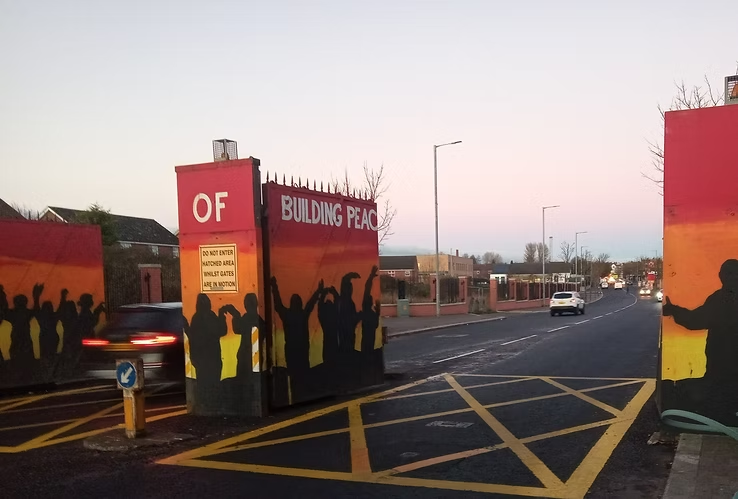
🧱 Peace Walls and Belfast’s Gates
One of Belfast’s most recognisable reminders of The Troubles is the Peace Wall.
During the conflict, physical barriers were built to separate communities and reduce violence.
Although many people expected them to be temporary structures, some still exist today, decades after the conflict ended.
The gates at Northumberland Street are among the best-known examples. Some remain closed at certain times, showing that while Belfast has changed enormously, some divisions from the past are still visible in the city landscape.
✨ What Do Belfast Murals Mean Today?
Today, Belfast’s murals have a complex meaning.
For some people, they remain important symbols of identity, memory and community. For others, they represent a difficult past that the city is still moving beyond.
What is clear is that murals are an essential part of Belfast’s history.
They are not simply tourist attractions. They help visitors understand how different communities remember the past and how Belfast has changed since the end of the conflict.
Modern Belfast is a more open and diverse city than during The Troubles, but its walls still tell the stories of those who lived through those years.
💡 Tips for Visiting Belfast Murals
🚶 Join a Local Guided Tour
Belfast murals are full of symbols, references and hidden details that can easily be missed.
A local guide can explain the historical context and the human stories behind the images.
📸 Respect the Neighbourhoods
Many murals are located in residential areas.
Although they are popular with visitors, they are still living communities where people work and live every day.
📚 Learn the Context Before Visiting
Seeing a mural without understanding its background is simply seeing a painting.
Understanding The Troubles, community divisions and Belfast’s transformation completely changes the experience.
🕊️ Belfast Murals: A Story the City Still Carries
Belfast’s murals are much more than paint on brick.
They are memory, identity and a window into a recent history that continues to shape the city.
Walking through Falls Road, Shankill Road and the Peace Walls allows visitors to discover how Belfast went from being one of the main stages of conflict to becoming a city looking towards the future while remembering its past.
If you want to discover Belfast’s murals with a local guide and understand the stories behind them, join our Belfast Political Tour, where you can explore The Troubles, the Peace Walls and the history behind some of the city’s most famous murals.


