Belfast City Hall: History, Secrets and Stories from the Heart of the City

If there is one building that captures the story of modern Belfast, it is Belfast City Hall.
Standing at the centre of Donegall Square, this enormous stone building dominates the heart of the city and is one of the first sights many visitors see when they arrive in Belfast.
But City Hall is much more than an impressive building to photograph.
Its history is closely connected to the moment Belfast became a city, the enormous wealth generated by the linen industry, the rise of Harland & Wolff’s shipyards, the Titanic, the Second World War and some of the political events that shaped Belfast during the 20th century.
Even details that are easy to overlook, such as the stained glass, the Belfast coat of arms and the statues around the grounds, tell small parts of the city’s story.
If you want to understand Belfast, City Hall is a very good place to start.

🏙️ Why Was Belfast City Hall Built?
To understand the story of City Hall, we need to go back to 1888.
That was the year Queen Victoria granted Belfast city status.
It was no minor recognition.
During the 19th century, Belfast had grown enormously thanks to trade, the linen industry, engineering and, increasingly, shipbuilding.
The city was no longer the small port it had been just a few generations earlier.
It had become a wealthy, ambitious and rapidly expanding industrial city.
So a new municipal building was planned that would reflect Belfast's new status.
The idea was to create a monumental building that represented the power, prosperity and importance the city had achieved.
And the result was certainly spectacular.
🏛️ A Building Designed to Impress
The architect behind the project was Alfred Brumwell Thomas, who designed City Hall in the Baroque Revival style.
The building was constructed mainly from Portland stone, with work beginning towards the end of the 19th century.
The foundation stone was laid in 1898, and the building took eight years to complete.
Finally, the doors of Belfast City Hall opened on 1 August 1906.
The cost was around £369,000, an enormous sum at the time.
According to Belfast City Council, that would be equivalent to around £128 million today.
But the money was not simply spent on creating municipal offices.
City Hall was designed as a statement.
Belfast at the beginning of the 20th century wanted to show the world what it had achieved.
The building had the size, decoration and grandeur to do exactly that.

💰 The Wealth of Industrial Belfast
When City Hall opened its doors in 1906, Belfast was experiencing one of the most prosperous periods in its history.
The linen industry had turned the city into one of the world's leading textile centres.
The shipyards were building enormous vessels.
Factories produced rope, tobacco, machinery and a wide range of other industrial goods.
The port connected Belfast with Great Britain and international markets.
All that wealth needed a symbol.
City Hall fulfilled that role perfectly.
Its enormous dome, columns, sculptures and marble interiors contrasted sharply with the industrial streets and working-class neighbourhoods that had grown up around the factories and shipyards.
In many ways, it was the building that represented Belfast's emergence as an industrial powerhouse.
🚢 City Hall and the Titanic: An Unexpected Connection
The connection between City Hall and the Titanic is closer than many visitors realise.
One of the figures connected with both stories was William Pirrie, a member of the family that owned Harland & Wolff and Lord Mayor of Belfast in 1896–1897.
Pirrie was involved in many of the major projects that were transforming Belfast at the beginning of the 20th century.
Many of the skilled workers involved in the interior finishing of City Hall also came from Harland & Wolff.
This helps explain some of the similarities between the municipal building's interiors and the luxurious interiors of the great ocean liners built in Belfast.
So, when you walk through City Hall, you are also seeing a small example of the craftsmanship of the workers who made Belfast's shipbuilding industry famous.
The connection between the two is another example of how different parts of Belfast’s history are closely intertwined.
🪟 The Impressive Stained Glass of City Hall
One of the great treasures inside City Hall is its stained glass.
Many of the original windows were installed when the building opened in 1906.
They are far more than decorative features.

Some depict events from Belfast's civic history, while others feature coats of arms connected with the city, Ireland, Ulster and the British monarchy.
The main staircase is particularly impressive.
It is illuminated by 21 original stained-glass windows, including seven large windows depicting coats of arms and important figures from Belfast's history.
They also include references to civic events ranging from the granting of Belfast's charter in 1613 to its transformation into a county borough in 1899.
In other words, before you even reach the main rooms, the building is already telling the story of Belfast.
💥 City Hall During the Belfast Blitz
City Hall also experienced one of the most dramatic episodes in Belfast's history.
In 1941, during the Second World War, Belfast was bombed by the German Luftwaffe.
The attacks, known as the Belfast Blitz, caused widespread destruction across the city and resulted in thousands of casualties.
City Hall was not spared.
The Great Hall suffered a direct hit and was almost completely destroyed.
But there is an extraordinary story behind its stained-glass windows.
Before the bombing, the windows had been removed on the orders of the Lord Mayor and stored in a safe location in County Down.
As a result, many of the original windows could be returned to the building when the Great Hall was restored in 1952.
And the stained glass is not the only reminder of that episode. One of the portraits inside the building still bears visible damage from the bombing. It is a portrait of the Lord Mayor at the time, Sir Crawford McCullagh, whose canvas was split by shrapnel precisely at neck level.
It is the kind of small detail that can easily go unnoticed when visiting City Hall, but it helps show that the Belfast Blitz did not happen somewhere far away. Its consequences were literally left behind in the building itself.
Today, when visitors look at those windows and that portrait, they are seeing objects that survived one of the most destructive episodes in Belfast's history.
🕯️ Inside City Hall: Marble, Staircases and a Gallery of Lord Mayors
The interior of City Hall was designed to impress.
The grand staircase leads to a spectacular rotunda lined with Italian and Greek marble.
From there, visitors can access various rooms and ceremonial spaces.
Guided tours also allow visitors to see portraits of the Lord Mayors of Belfast.
A new portrait is added each year, creating a gallery that traces Belfast's civic and political history through its mayors.
Other highlights include a mural by John Luke and a gallery known as the Whispering Gallery, located high up inside the dome.

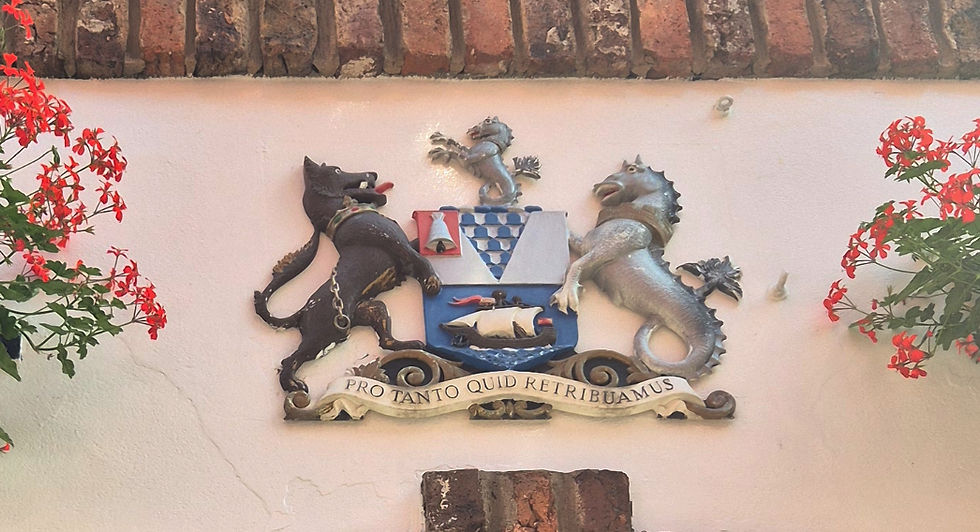
🔔 Belfast's Curious Coat of Arms
One detail worth looking for inside City Hall is the Belfast coat of arms.
The current coat of arms was officially granted in 1890, shortly after Belfast received city status.
It features several symbols:
⚓ A ship, reflecting Belfast's maritime importance.
🐴 Two seahorses, also referring to the city's connection with the sea.
🔔 A bell.
🐺 A chained wolf.
Interestingly, the exact original meaning of these symbols is not entirely clear.
The same motifs had already been used by Belfast merchants during the 17th century on signs, coins and other commercial items.
The coat of arms also features the Latin motto: “Pro tanto quid retribuamus”
It can be translated as: “What shall we give in return for so much?”
The motto comes from Psalm 116:12.
🌳 The Grounds Around City Hall
City Hall does not end at the building's doors.
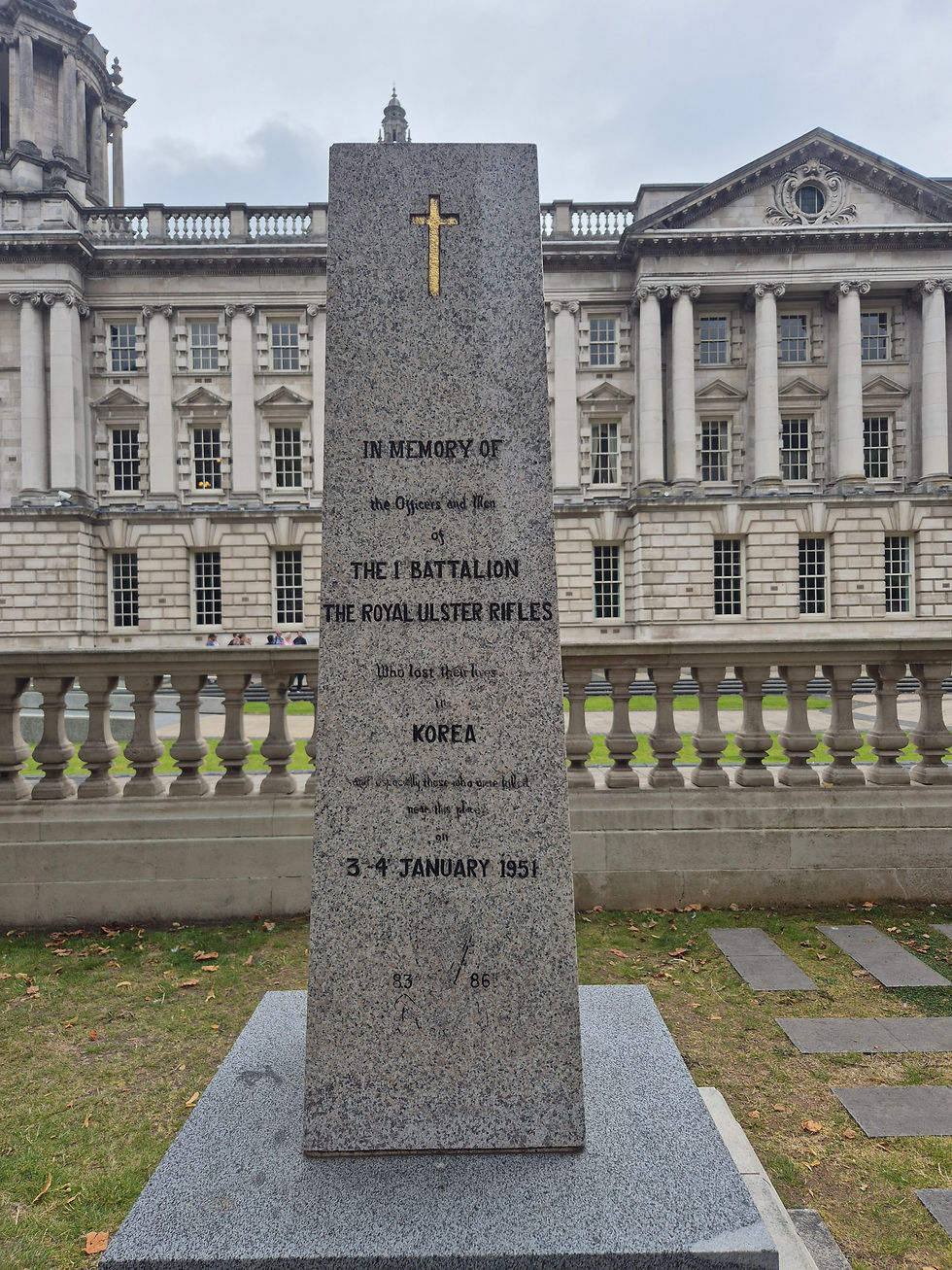
The grounds surrounding it are an important part of the experience and contain a number of monuments and memorials connected with Belfast's history.
One of the best known is the Titanic Memorial Garden.
It contains the names of the people from Belfast who died in the Titanic disaster.
This creates another connection between City Hall and one of the city's most famous stories.
The Cenotaph, a memorial to those who died in wars, can also be found here.
There are also other memorials and sculptures dedicated to different people and events connected with Belfast.
So it is worth exploring the grounds even if you do not have time to go inside the building.
⚔️ City Hall and Belfast's Memory
City Hall also shows that Belfast's history cannot be reduced to its industrial past.
The building has been the setting for ceremonies, political events, celebrations and moments of mourning.
Among the more recent additions is a fountain dedicated to council workers who were killed or injured during the period of the Troubles, between 1969 and 1999.
The fountain was intended as a symbol of hope, renewal and a new beginning.
It is a relatively understated feature, but it reflects something important about Belfast: different layers of the city's history continue to exist within the same spaces.
👑 A Square at the Heart of Belfast
The location of City Hall is no coincidence.
It stands in Donegall Square, right at the geographical and symbolic heart of Belfast.
From here, you can walk to some of the city's most important areas.
Just a few minutes away are the Linen Quarter, the Crown Liquor Saloon, the Grand Opera House and Belfast's main shopping streets.
Walk north and you will reach the Cathedral Quarter.
To the east are the Albert Memorial Clock and the River Lagan.
Continue towards the former harbour and you will eventually reach Titanic Quarter.
This makes City Hall an excellent point from which to get your bearings and understand how Belfast fits together.
It is not simply a building to visit.
It is one of the places from which the city opens out in every direction.
🚶 Can You Visit Belfast City Hall?
Yes. You can explore the grounds and admire the exterior of City Hall independently, but it is also possible to visit the interior and learn more about its history.
Public guided tours currently have a small admission fee and last approximately 45–50 minutes. They provide access to areas that are not normally open to the public, including the Rotunda, the grand staircase, the Robing Room and other rooms within the building.
City Hall also has a Visitor Exhibition, a self-guided exhibition covering Belfast's history from the past to the present through six themed areas. The exhibition has its own opening hours and access conditions, so it is worth checking the official information before your visit.
🧭 City Hall: A Small History of Belfast in One Building
Perhaps the most interesting thing about Belfast City Hall is that it does not represent just one period of the city's history.
Its walls contain references to 17th-century Belfast.
Its construction reflects the wealth of the city's 19th-century industrial age.
Its interiors are connected with the same skilled workers who built some of the most famous ships at Harland & Wolff.
Its stained glass survived the Belfast Blitz.
Its grounds commemorate the Titanic, the wars and other chapters of the city's history.
And the building continues to serve as Belfast's civic centre today.
In short, City Hall is almost an architectural summary of Belfast.
Belfast grew through trade, became wealthy through industry, built ships that became famous around the world, experienced war and conflict, and later began building a new chapter.
All of that can be found, in one way or another, around this square.
❤️ Why Visit Belfast City Hall?
You can visit City Hall simply because it is one of the most impressive buildings in Belfast.
But once you know what you are looking at, the experience changes.
The next time you pass through Donegall Square, take a moment to look at the dome, the details on the façade, the statues and the surrounding grounds.
And if you have time, go inside.
Look at the stained glass.
Find the Belfast coat of arms.
Look at the portraits of the Lord Mayors.
Think about the Harland & Wolff workers who helped create its interiors.
And remember that this same building survived the Belfast Blitz and continues to play a role in the life of the city more than a century after it opened.
Because Belfast City Hall is not simply Belfast's City Hall.
It is one of the places where the history of the city is still alive.
🚶 Discover Belfast City Hall and the City Centre
City Hall is one of the key places for understanding Belfast and one of the main stops on our city centre walking tour.
During the tour, we explore the history of the city, its industrial transformation, its most important buildings and the people who helped shape Belfast into the city we know today.
If you want to discover the stories hidden behind the streets and buildings of the city centre, join our Belfast Free Walking Tour